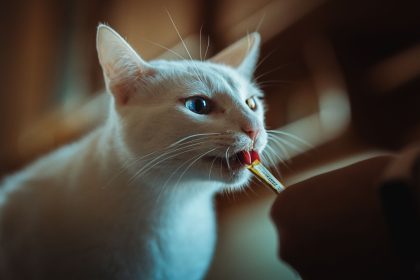
A cat can survive for about 3 to 7 days without eating, but serious health damage can begin after just 24–48 hours. Unlike humans, cats are highly sensitive to food deprivation, and even short periods...

Gentle cat biting happens because cats use their mouths as a form of communication. In most cases, a gentle bite signals affection, overstimulation, play behavior, or a need for space. The behavior fe...

A kitten can appear almost adult-sized within its first year, but physical maturity does not always happen at the same time as visible growth. Cats continue developing after they reach their approxima...

Cats’ tails do not fall off naturally. If a cat loses part or all of its tail, it is due to a serious injury, infection, circulation loss, or a medical amputation performed by a veterinarian. Un...

As a pawrent, one of the first questions you ask before bringing home a Bengal is: “How big do Bengal cats actually get?” The short answer: Bengal cats are medium-to-large cats with athlet...

Cats open their eyes between 7 and 14 days after birth. Most kittens begin opening their eyes around day 7–10, but full eye opening and functional vision develop gradually over the following wee...

Cats can become pregnant much earlier than many people expect. A female cat does not need to be fully grown before she can reproduce, which is why understanding feline reproductive cycles is important...

A cat’s lifespan is influenced by much more than age alone. Nutrition, veterinary care, genetics, lifestyle, environment, and daily habits all play a role in determining how many healthy years a cat m...

Many cat owners notice a familiar pattern: their cat follows them from room to room, waits outside a door, sits nearby while they work, or suddenly appears whenever they move around the house. Althoug...

Domestic cat reproduction is a natural biological process, but it involves more than simply allowing a male and female cat to be together. Cats have specific behaviours, reproductive cycles and physic...