Ask what species a dog belongs to and two scientific names are likely to appear: Canis lupus familiaris and Canis familiaris. That apparent contradiction does not mean scientists disagree about what a domestic dog is. It reflects different taxonomic conventions for describing a domesticated lineage that originated from gray wolves.
The distinction matters because “species,” “subspecies,” and “breed” are not interchangeable terms. A Labrador Retriever and a Chihuahua are different breeds, not different species. At the same time, major biological databases do not all assign the domestic dog exactly the same taxonomic rank.
The Short Answer: Dogs Belong to One Domestic Lineage
Domestic dogs belong to the genus Canis and the family Canidae. Their scientific classification is commonly expressed in one of two ways:
- Canis lupus familiaris when the domestic dog is classified as a subspecies of the gray wolf, Canis lupus.
- Canis familiaris when the domestic dog is treated as a distinct species-level taxon.
Both names refer to the domestic dog lineage. The difference is primarily one of taxonomic treatment rather than evidence that there are two fundamentally different kinds of domestic dog.
Why Scientific Databases Give Different Answers
As of 2026, the disagreement remains visible in major reference databases. NCBI Taxonomy uses Canis lupus familiaris as the current name for the dog and assigns it the rank of subspecies. In that system, Canis familiaris is listed as a synonym.
The Mammal Diversity Database takes a different approach. Its July 2026 release recognizes the domestic dog as Canis familiaris while explicitly describing it as the domestic form of Canis lupus. The database therefore acknowledges the dog’s wolf origin while retaining a species-level name for the domesticated lineage.
ITIS likewise recognizes Canis familiaris as a valid name and treats the combination Canis lupus familiaris differently in its nomenclatural system.
This is an important practical point: there is no need to “correct” every use of one name to the other without considering context. A genetics database, mammal taxonomy database, veterinary publication, archaeological study, or university style guide may follow a particular convention.
Dog Taxonomy at a Glance
| Rank | Classification | What It Means |
|---|---|---|
| Kingdom | Animalia | Dogs are animals |
| Phylum | Chordata | They belong to the chordates |
| Class | Mammalia | Dogs are mammals |
| Order | Carnivora | They belong to the carnivoran order |
| Family | Canidae | The dog family also includes wolves, coyotes, foxes, and related canids |
| Genus | Canis | Dogs belong to the same genus as several closely related canids |
| Scientific name | Canis familiaris or Canis lupus familiaris | The preferred form depends on the taxonomic authority being followed |
Dog Breed and Dog Species Are Not the Same Thing
One of the most common sources of confusion is the phrase “species of dogs.” In everyday conversation, people often use “species” when they actually mean “breed.” Biologically, these concepts operate at very different levels.
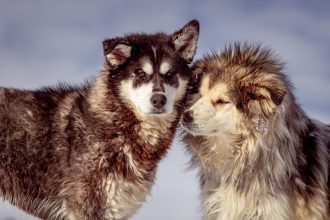
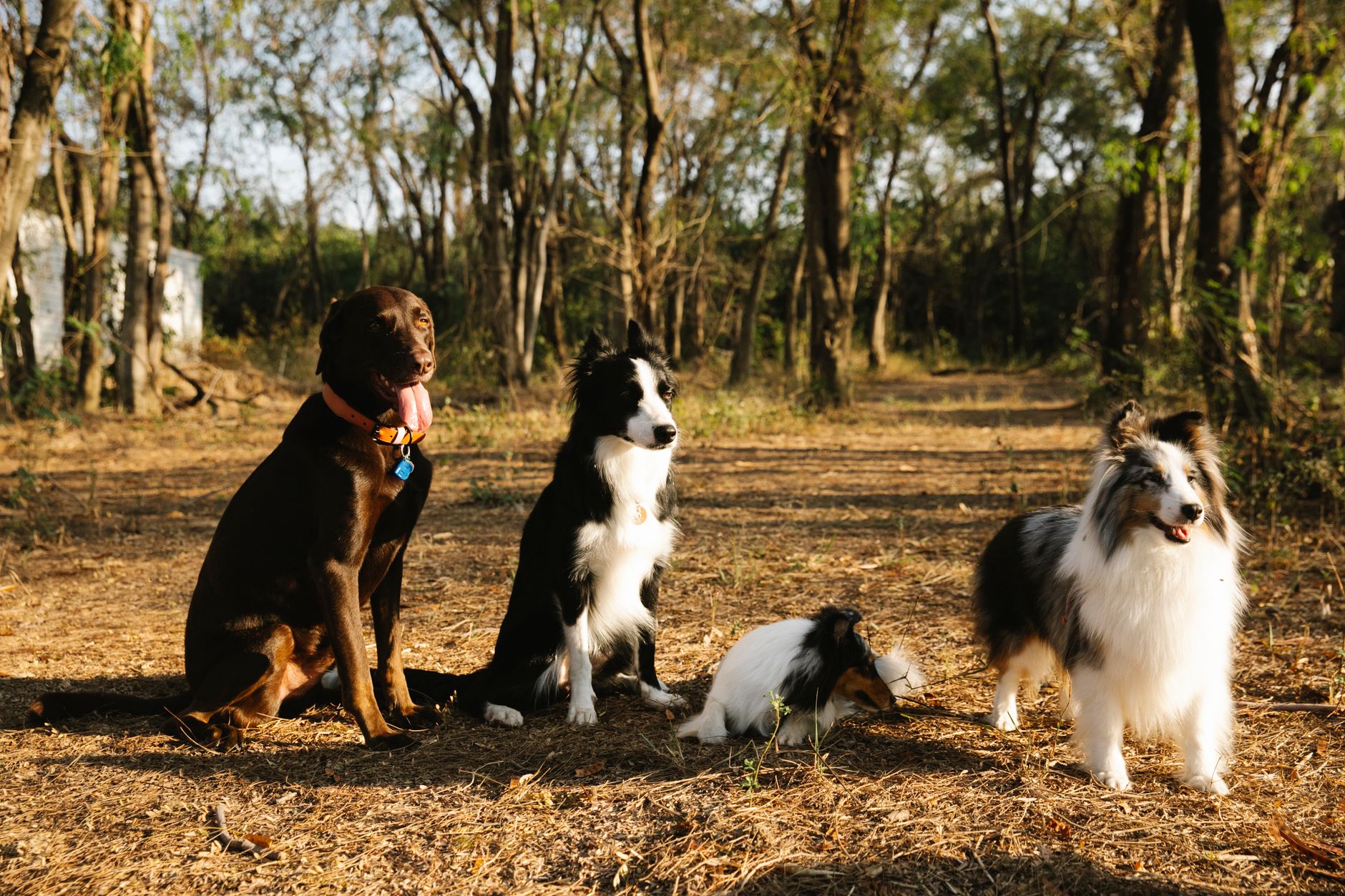
A German Shepherd, Beagle, Poodle, Siberian Husky, and Great Dane belong to the same domestic dog lineage. Their differences result largely from selective breeding and population history rather than their belonging to separate species.
| Term | Meaning | Example |
|---|---|---|
| Species or domestic taxon | The broader biological classification of the domestic dog | Canis familiaris |
| Subspecies treatment | Classification of the dog within the gray wolf species | Canis lupus familiaris |
| Breed | A selectively developed population within domestic dogs | Beagle |
| Family | A much broader group containing multiple genera and species | Canidae |
Physical appearance is therefore a poor shortcut for deciding whether two animals are separate species. Domestic dogs can differ dramatically in body size, skull shape, coat, behavior, and working characteristics while remaining members of the same domesticated lineage.
Are Dogs Technically Wolves?
Evolutionarily, domestic dogs descended from ancient gray-wolf populations. But saying that a pet dog is simply a modern gray wolf compresses a long and complex evolutionary history into an overly simplistic statement.
Modern dogs were not created from any single living wolf population that can simply be identified today as their direct ancestor. Genomic evidence instead points toward ancient wolf populations, including lineages that are extinct or no longer represented in their original form.
That distinction becomes especially important when interpreting the name Canis lupus familiaris. Classifying dogs within Canis lupus highlights their close evolutionary relationship with gray wolves. It does not imply that a modern domestic dog and a present-day wild wolf are behaviorally, ecologically, or historically interchangeable.
What the Latest Genomic Research Adds
Research published in 2026 has sharpened the timeline of early dogs without resolving every question about where domestication first began.
Genome-wide research on prehistoric European canids identified a dog from Kesslerloch in Switzerland dating to roughly 14,200 years ago. Its ancestry connects it with later dogs, indicating that genetic diversification within the dog lineage had already begun by that period.
A separate 2026 genomic study examined ancient canids from western Eurasia and identified dogs from Pınarbaşı in present-day Türkiye dating to approximately 15,800 years ago and from Gough’s Cave in Britain dating to about 14,300 years ago. The results indicate that a genetically recognizable dog population was already distributed across parts of Europe and Anatolia during the Late Upper Palaeolithic.
This matters because the genetic history no longer supports an overly simple picture in which recognizable domestic dogs emerged only much later alongside farming communities. Dogs predate agriculture as a domestic lineage, and the latest ancient-DNA evidence places genetically identifiable dogs among Late Ice Age human populations.
What the New Evidence Does Not Prove
Older dates do not automatically reveal one precise location where a wolf first became a dog. The geographic origin of dog domestication remains unresolved.
Earlier genomic research found that dogs overall have stronger ancestry relationships with ancient eastern Eurasian wolves than with ancient western Eurasian wolves. At the same time, some dog populations also carry evidence consistent with ancestry from an additional western wolf-related source.
Research on extinct Japanese wolves has added another layer. Genomic analysis found Japanese wolves to be particularly closely related to the dog lineage and detected ancient Japanese-wolf-related ancestry in East Eurasian dogs. Those findings strengthen the case for an important East Eurasian component in early dog history, but they do not provide a final geographical answer to domestication.
The safest interpretation is therefore not “dogs definitely originated at one proven location,” but that dog domestication involved ancient wolf populations whose relationships and movements are still being reconstructed from archaeological and genomic evidence.
Can Dogs and Wolves Still Interbreed?
Yes. Dogs and gray wolves remain genetically close enough to produce hybrid offspring. That biological compatibility is one reason the species-versus-subspecies question can seem straightforward at first glance.
However, the ability to hybridize is not, by itself, sufficient to settle taxonomic rank. Closely related animal populations can exchange genes while maintaining distinct evolutionary histories, ecological roles, and population identities.
The 2026 ancient-genome evidence is particularly informative here. Researchers found that Late Upper Palaeolithic dogs in western Eurasia were already largely reproductively separated from wolves. Despite dogs and wolves continuing to occupy overlapping regions, later wolf ancestry in the dog populations studied was relatively limited apart from specific episodes of admixture.
In practical terms, early dogs were not simply wild wolves continually blending back into surrounding wolf populations. They had already developed a recognizable population history of their own.
Does “Canine” Mean Domestic Dog?
No. “Canine” can refer to a much broader biological group. Domestic dogs belong to the family Canidae, which includes numerous wild canids. Similarly, the genus Canis is not exclusive to domestic dogs.
This creates another common terminology problem. A wolf is a canid, and a dog is a canid, but a canid is not necessarily a domestic dog.
- Domestic dog: the domesticated lineage discussed as Canis familiaris or Canis lupus familiaris.
- Gray wolf: Canis lupus.
- Canis: the genus containing dogs and several closely related canids.
- Canidae: the broader family containing dogs, wolves, foxes, and other canids.
Which Scientific Name Should You Use?
For casual writing, “domestic dog” is usually the clearest expression because it avoids an unnecessary taxonomic argument.
For scientific work, the correct choice should follow the authority or dataset being used. If research relies on NCBI genomic records, Canis lupus familiaris is the consistent choice because NCBI currently assigns the domestic dog subspecies status under Canis lupus.
If the work follows the Mammal Diversity Database’s current mammalian taxonomy, Canis familiaris is appropriate. The same general approach is useful when working with museum collections, biodiversity databases, veterinary datasets, or archaeological records: adopt one defined authority and remain consistent throughout the document.
So, What Species Are Dogs?
Domestic dogs do not consist of multiple species corresponding to their different breeds. They form one domesticated evolutionary lineage descended from ancient gray wolves.
The scientific name depends on the taxonomic framework. Under the subspecies approach used by NCBI, a dog is Canis lupus familiaris, a domestic subspecies of Canis lupus. Under the species-level treatment used by the current Mammal Diversity Database and recognized by ITIS, the domestic dog is Canis familiaris.
For most readers, that is the key distinction to remember: a Poodle and a Husky are different breeds, not different species, while the two scientific names commonly used for domestic dogs represent competing taxonomic conventions for the same extraordinary domesticated lineage.