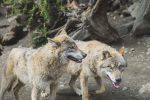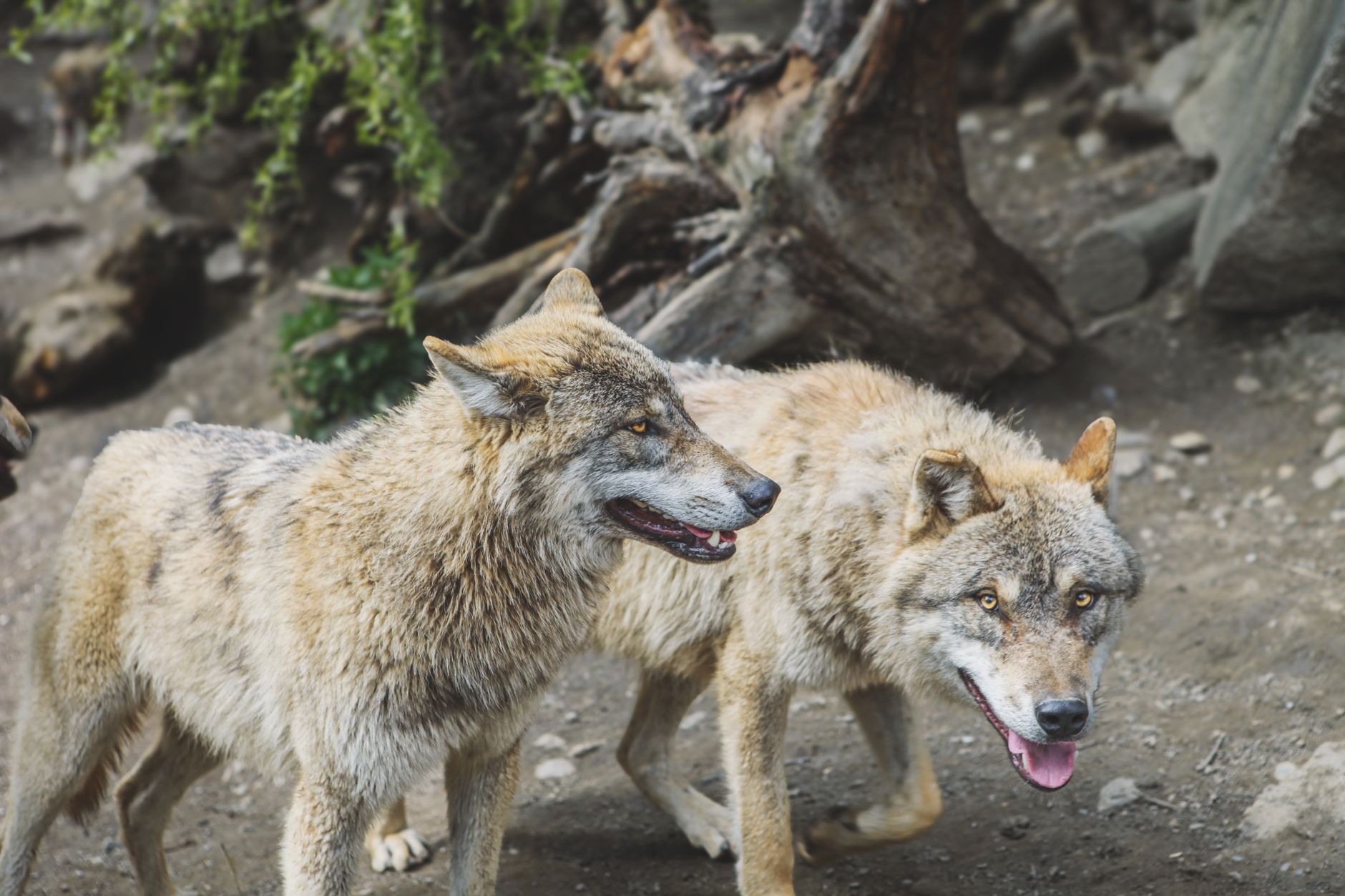
Domestic dogs are descended from ancient wolf populations, but saying that dogs simply “came from wolves” can create the wrong picture. Modern dogs did not evolve directly from the gray wolves living today. Instead, dogs and present-day gray wolves are closely related branches whose histories trace back to ancestral wolf populations.
That distinction matters because domestication was not a case of people turning today’s wolves into Labradors, Chihuahuas, or German Shepherds. It was a long evolutionary process involving ancient wolves, humans, changing environments, and eventually deliberate selective breeding.
The Short Answer: Dogs Have Wolf Ancestry
Yes, all domestic dogs share ancestry with ancient wolves. Genetic evidence places dogs within the broader wolf lineage and explains why dogs and gray wolves remain so closely related biologically.
However, the ancestral wolf population that gave rise to dogs is not simply equivalent to a modern wolf population that can be pointed to today. The precise population history of early dogs remains an active area of scientific research.
A more accurate summary is:
Domestic dogs descended from ancient wolves, while modern wolves represent related lineages that also continued evolving.
Why “Dogs Came From Modern Wolves” Is Misleading
Evolution is better represented as a branching tree than a straight ladder.
Imagine an ancestral wolf population living thousands of years ago. Over time, some wolf populations continued along evolutionary paths that contributed to wolves known today, while another lineage became increasingly associated with humans and eventually developed into domestic dogs.
This means a modern wolf is better understood as a dog’s close evolutionary relative rather than its direct modern-day ancestor.
| Statement | How Accurate Is It? |
|---|---|
| Dogs are related to wolves | Accurate |
| Dogs have ancient wolf ancestry | Accurate |
| A modern gray wolf directly turned into today’s dog breeds | Misleading |
| Dogs and modern wolves share evolutionary ancestry | Accurate |
How Could Wolves Have Become Dogs?
There was probably no single moment when a wolf suddenly became a dog. Domestication would have taken place across many generations.
One widely discussed model begins with certain wolves becoming more tolerant of living near human communities. Human settlements could provide access to discarded food and other resources, creating an advantage for animals that were less fearful or aggressive around people.
Over generations, wolves that tolerated human proximity may have gained access to resources that more wary animals avoided. Humans, meanwhile, may have increasingly benefited from animals that could assist with tasks such as detecting danger, locating animals, or participating in hunting.
The exact sequence is difficult to reconstruct because the earliest stages happened in prehistory. Domestication may also have involved more complicated interactions than a single simple pathway.
Domestication and Selective Breeding Are Different Stages
The enormous variety of modern dog breeds did not appear when dogs first separated from ancestral wolves.
It helps to distinguish two processes:
- Domestication involved the long-term biological and behavioral adaptation of ancestral dogs to living alongside humans.
- Selective breeding involved humans choosing particular dogs to reproduce because they had useful or desirable traits.
The first process created the domestic dog lineage. The second eventually generated much of the extraordinary diversity seen among dogs today.
Why Dogs Began Looking Different From Wolves
Once dogs were living and reproducing within human environments, different selective pressures could influence their appearance and behavior.
Traits potentially affected over generations included:
- body size;
- coat type and color;
- ear and tail characteristics;
- temperament;
- social behavior around people;
- hunting behavior;
- guarding tendencies;
- ability to perform particular working tasks.
Later, intentional breeding dramatically accelerated these differences. Humans selected dogs for hunting, livestock management, guarding, companionship, transport, and many other roles.
How Can a Chihuahua and a Great Dane Both Come From Wolves?
The difference seems extraordinary because modern breeds can vary enormously in size and appearance. Yet those differences developed within the same domestic dog lineage through generations of selective breeding.
Humans repeatedly bred dogs displaying particular traits. If smaller size was desired, smaller dogs could be selected. If strength, coat characteristics, speed, or particular behavior was useful, those traits could also be emphasized across generations.
Selection can produce substantial physical variation without creating a completely separate species for every breed.
That is why a Chihuahua and a Great Dane can look radically different while both remaining domestic dogs.
Did Every Dog Breed Come From Wolves Separately?
No. Today’s breeds were not created by independently domesticating a wolf population for each breed.
Modern breeds developed much later within the already established domestic dog population. Breed histories can involve different regional dog populations and extensive mixing, but they ultimately belong to the same broader domesticated lineage.
A Poodle therefore does not have one separate wolf origin while a Husky has another completely independent origin simply because the two breeds look different.
Are Some Dog Breeds “More Wolf” Than Others?
This phrase can mean several different things and therefore requires care.
Some breeds retain physical characteristics that people strongly associate with wolves, such as upright ears, thick coats, long muzzles, and particular body proportions. Appearance alone does not mean that those dogs are fundamentally closer to being wild wolves in everyday behavioral terms.
Breed histories also differ, and some dog populations may preserve genetic patterns that are informative about early canine lineages. But every ordinary domestic breed is still part of the domestic dog population.
Looking wolf-like and being evolutionarily “more wolf” are not the same concept.
What About Wolf-Dog Hybrids?
Dogs and wolves are closely related enough that hybridization can occur. A wolf-dog hybrid, however, is not the same thing as an ordinary dog simply because all dogs have ancient wolf ancestry.
The distinction is between:
- ancient shared ancestry found throughout domestic dogs; and
- recent wolf ancestry resulting from comparatively recent breeding between wolves and dogs.
Those are very different situations biologically and behaviorally.
Are Dogs Still Wolves?
Domestic dogs are closely related to gray wolves and are commonly classified as Canis lupus familiaris, placing them as a domestic subspecies within Canis lupus. Some taxonomic treatments have also used Canis familiaris.
Taxonomic terminology should not obscure the practical distinction. Domestic dogs have undergone extensive evolutionary and behavioral change under domestication and are not simply tame versions of wild wolves.
Dogs have adapted to a human-associated environment in ways that affect their development, social behavior, feeding ecology, reproduction, and interactions with people.
Domestication Changed More Than Appearance
The most important changes separating dogs from their ancestral wolf populations are not limited to coat colors and floppy ears.
Living alongside humans placed different demands on dogs. Animals that could tolerate people, interpret human behavior, reproduce successfully in human environments, and take advantage of available resources had opportunities that wild wolves did not experience in the same way.
Over many generations, those pressures contributed to a domestic animal with a distinctive relationship to humans.
Dogs Did Not Stop Evolving After Domestication
Domestication was not the end of canine evolution. Dog populations continued changing as they moved with humans into different regions and encountered new environments, diets, diseases, tasks, and breeding preferences.
Some populations developed primarily through local environmental and human influences. Others eventually became formal breeds shaped by increasingly controlled breeding programs.
The result is that dog evolution has multiple layers:
- ancient wolf ancestry;
- early domestication;
- development of regional dog populations;
- selection for particular working or behavioral roles;
- more recent formation of standardized breeds.
Why Scientists Still Debate the Details
Researchers broadly agree that dogs have ancient wolf ancestry, but reconstructing exactly where, when, and how domestication occurred is difficult.
Several factors complicate the picture:
- the earliest events occurred deep in prehistory;
- ancient populations disappeared or changed;
- wolves and early dogs could exchange genes;
- dog populations moved alongside humans;
- archaeological remains can be difficult to classify as early dogs or wolves;
- genetic evidence becomes more complex when populations repeatedly mix.
As new ancient DNA and archaeological evidence becomes available, details of the domestication story can be refined. Scientific uncertainty about those details does not undermine the broader evidence connecting dogs with ancient wolves.
Did Humans Capture Wolf Puppies and Create Dogs?
It is possible that humans sometimes raised individual wolf pups, but reducing domestication to people deliberately capturing wolves and breeding them into dogs oversimplifies the process.
Domestication operates across populations and generations. Individual tame animals are not automatically domesticated animals.
A wild animal can become accustomed to humans during its lifetime without its entire species undergoing the inherited biological changes associated with domestication.
Dogs emerged from a much longer evolutionary process.
Tame and Domesticated Do Not Mean the Same Thing
This distinction helps explain the dog-wolf relationship.
| Term | Meaning |
|---|---|
| Taming | A change in an individual animal’s behavior toward people during its lifetime |
| Domestication | Inherited changes occurring across populations over many generations under human-associated selection |
A tame wolf remains a wolf. Domestic dogs represent a lineage shaped by generations of domestication.
Why Dogs and Wolves Still Share So Many Traits
Their close evolutionary relationship explains numerous similarities.
Both are social canids with sophisticated communication systems, strong senses of smell, predatory ancestry, and many shared anatomical characteristics.
But similarities should not be used to assume that normal wolf behavior and domestic dog behavior are interchangeable. Thousands of generations living in different ecological and social conditions have produced meaningful differences.
Why This Matters for Understanding Dog Behavior
Dog owners sometimes use wolf behavior as a direct instruction manual for handling domestic dogs. That can lead to misleading conclusions.
Dogs certainly inherited aspects of their biology from canid ancestors, but modern canine behavior has also been shaped by domestication, individual development, breed selection, learning, and interaction with humans.
A pet dog’s behavior is therefore better understood by studying domestic dogs directly rather than assuming that every action must be explained through comparisons with wild wolf packs.
The Better Way to Describe Where Dogs Came From
So, did dogs come from wolves? Yes, but with an important qualification.
Dogs descended from ancient wolf populations through a long process of domestication. Modern gray wolves and domestic dogs are closely related, but today’s wolves should not be imagined as unchanged ancestors that simply transformed into modern dog breeds.
The dogs living in homes today are the product of several stages of change: ancient wolf ancestry, early interactions with humans, domestication, migration alongside people, and eventually extensive selective breeding.
That history explains an apparent contradiction. Every Chihuahua, Greyhound, Mastiff, Terrier, and mixed-breed dog belongs to a lineage rooted in ancient wolves, yet the domestic dog has become an animal with its own remarkable evolutionary history.